
Writers' Rooms
Part One: My Way in and What You Should Know

The fact that you sit at your desk writing things that you’ve pulled from your imagination in the hope that someone will pay you for them makes you a bit different to the ordinary five-eighth.
But imagine being invited into a room full of other oddballs like you, who understand exactly why finding a plothole in your meticulously structured fictional world is enough to grind every other plan you had to a halt until you’ve resolved it.
Better yet, imagine walking into that room and, after an hour or so, realising that you’re not even close to being the biggest weirdo in it, and yet, you’ve never felt more at home.
Well, that’s kind of what most writers’ rooms are like.
Getting Your Foot in the Door
To point out the obvious, this is the trickiest part. It’s not simply down to talent and having a great sample script - the key ingredient is opportunity.
I wasn’t hired as a writer for the first room I worked in. I was hired to be the story room’s ‘editorial assistant’ on Red Rock, a continuing police drama set in a fictitious Irish town. I had years of administrative experience before making the leap to try to earn a living as a screenwriter, which probably gave me a slight edge. But I had also run a couple of successful crowdfunding campaigns for two different film projects, and had a couple of credits, so they probably saw a guy who could organise and see things through to the end, who was also geared toward writing.
The interview was different to most others I have ever had. I met with the production manager, one of the main writers, and two executive producers, and for some reason, instead of babbling and waffling, I read the room and let them do most of the talking.
They already knew what was hampering their efforts and needed someone to put a shape on things and act as a conduit between story and production. I spoke a little about how to achieve what they wanted, and I expect it sounded like what they wanted, but I got the job because we hit it off as people.
For anyone trying to get a gig in a writers’ room at any level, forming a genuine rapport with the people assessing you for the role is crucial. Even if you don’t get it, they will remember you, which can speed up the process on future opportunities.
Red Rock
Working on Red Rock was an amazing experience. It had a dedicated story room and offices, where the head writer/showrunner, an executive producer, story producers, a researcher and story assistants all worked. The editorial assistant was the main point of contact between the story room and the rest of the production.
But I found a niche within the story room, which came from a place of pure necessity to control some of the chaos and keep order. I quickly realised that nobody was taking comprehensive notes during the roundtable story discussions, and the group regularly asked, “What was that thing you said about that other thing…?”, which inevitably led to a lot of wasted time trying to remember, or going off on other tangents.
So, I started to type practically everything I heard then, after hours, I’d review my notes, edit them, break them down into different sections and keep only the most valuable information, then I would distribute them to the team. It became part of my job and moved me from my desk to the discussion table, where I slowly but surely gained confidence and started to pitch in with my own ideas.
If you’re part of a story room, you must take advantage of your time at the table. It’s important to know how to communicate your ideas constructively, and sometimes you have to stick out your neck and tell everyone the daft idea in your head, because it’s surprising how something seemingly stupid can inspire a new idea among the group that often “breaks” the story.
Red Rock was a huge loss for writers and craftpersons of all disciplines in Ireland when it was abruptly cancelled. Countless writers wrote their first broadcast episodes on that show, and there was an academy in place to train new writers, give them the experience of going through the commissioning process, and then go on to write their own episode. It opened the door to the possibility of a career in writing.
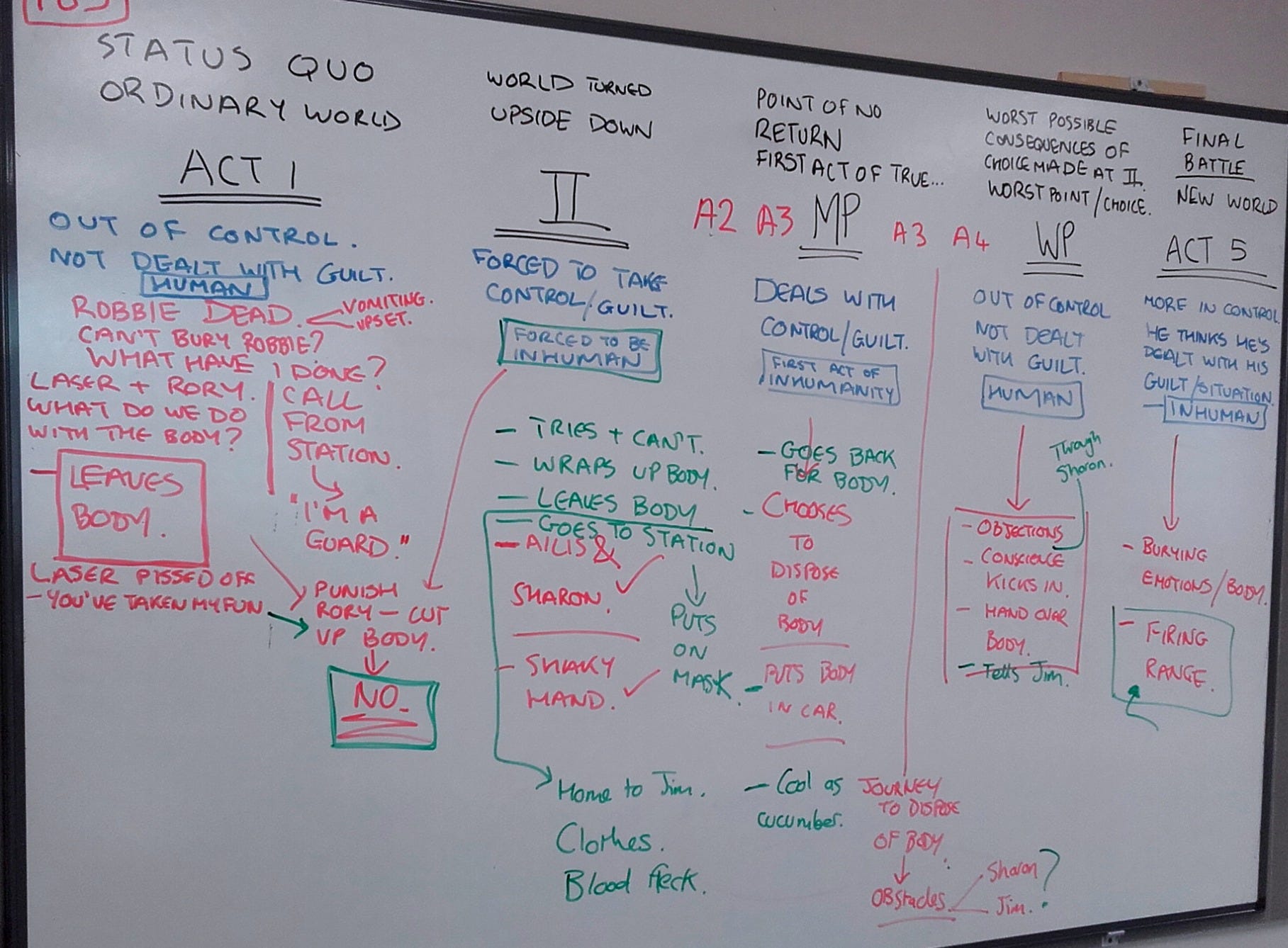
Red Rock whiteboard after breaking the story for an A-storyline in one episode. Shorthand details everywhere - this is why note-taking was essential!
The Second Room
The second room I participated in came about off the back of my work on Red Rock. Again, I wasn’t hired to contribute as a writer - what the hell is wrong with the idea of me as a writer?! - but instead, I was there to take notes and keep track of the discussions.
I put my head down, did the work to the best of my ability and was as accommodating as possible in terms of working with the room to support them in any other way I could. Toward the end, one of the producers dropped in to get a sense of the pitches and ideas that the team had come up with, and I got to introduce myself. It was all very brief, and I thanked her for the opportunity.
A few weeks after the room ended, she emailed me to ask if I would like to be considered for a writers’ assistant position for a show they were about to produce. She had read my notes and felt I was a good candidate.
The show was ‘Vikings: Valhalla’ - a massive production backed by MGM and Netflix.
I declined the opportunity… NO, OF COURSE I DIDN’T!
Vikings: Valhalla
I had to interview with the showrunner, Jeb Stuart, a writer held in high regard whose credits include Die Hard and The Fugitive. I’m from the era where people rented out video tapes, and I can confidently claim that I wore out copies of both movies when I was a teenager, so getting to speak with Jeb was a massive deal for me.
Cue palms sweating profusely.
The interview was more like a chat. Jeb was aware I wanted to write, which was a thrill, but his priority was ensuring that everything that went on in the writers’ room for the show was captured accurately and communicated clearly. Thankfully, I convinced him that I was the right person for the job.
The writers’ room took place in Ashford Studios in Wicklow. Big offices, huge production facilities, massive sets from the ‘Vikings’ show, a mere stone’s throw from the writers’ room. It’s the kind of place you dream of working in if you’re at all inclined toward this industry.
But when you’re there on day one, when a team of writers are figuring each other out and how to work together, the best thing you can do is focus on your job, unless you’re asked for something. They need to find their rhythm and work out a lot of story in a relatively short amount of time, so as much as possible, support that.
Inevitably, what will happen in any story room, and happened here, is that issues with stories crop up, and when the team is circling the drain and cannot break through, and you think you see an angle that may be useful, then that’s your moment to show your storytelling chops. Say your piece, and if it’s got legs, let them run with it.
When things work out as a result of the writers’ assistant or any other member of the team, you can feel pretty confident that the showrunner will hear about it. Most writers are very decent with things like that. They know you want to be where they are and, as much as possible, they want you to feel valued.
They’ve nothing to lose by doing this, by the way, because ultimately they will get the credit for the storylines in the wider world. Everyone’s a winner in that environment, but most importantly for you, that affords you a degree of credibility with those who make the decisions about the show, which can mean other opportunities.
Being Ready
I had a few years of writing spec scripts under my belt at this point, and returned to that after the Valhalla season one room finished up. Then, out of the blue, one of the producers asked me if I had a TV sample they could read, so that they could put me forward to write on a show… I did, but I asked for the weekend to “re-read it.”
The next 72 hours involved a frenzy of rewriting that script, practically from start to finish. Suddenly, I could see all of its faults and where it had more potential, so I worked it hard, printed it, redlined it, reprinted it, redlined it again, and rewrote it again, so that by the time I hit send on the email, I believed it was ready.
That script got me hired to write for Valhalla. I didn’t believe when they asked for a script that it was for that show. I didn’t think an opportunity like that was within reach at that point, regardless of having worked with the team on the first season. But there was a will within the higher-ups to bring through new talent, and fortunately, they liked my script, and it showed a degree of professionalism.
The big takeaway here is that if you’re serious about wanting to work in writers’ rooms, then you must have scripts that are well-worked and ready to send at the drop of a hat. Valhalla is set in Viking times, but the pilot script I submitted was an action thriller set in Texas, during a category five hurricane. That didn’t matter. What mattered was that it was ready, and it read well.
This experience taught me a valuable lesson, which to this day I live by - do your best work on every draft, because you never know when someone will want to read it.
Talk, Think, Talk, Think, Talk, Think
The vast majority of time spent in writers’ rooms is spent talking. If you’re an introvert, don’t worry, most of the others will be, too, but the difference is that you all will want to talk at some point, because it’s about building worlds and creating stories.
There’s a lot of sitting around, writing on whiteboards, flip charts and scribbling things on notepads. There’s also a lot of pacing about, thinking around ideas, throwing rubber balls against the wall, drinking coffee and eating bad food.
You will also draw on your own experiences. A LOT of the best ideas come from things writers have gone through in the real world. As such, it’s usually a very open room, because to get to the really juicy stuff, people have to feel like they can be themselves, and share anything and everything in service of a story or a character.
Every single person in the room has their own modus operandi, but somehow, once the right idea is identified in its orbit, the whole team will find the right way to work together to land it. And that’s pretty exhilarating to be part of.
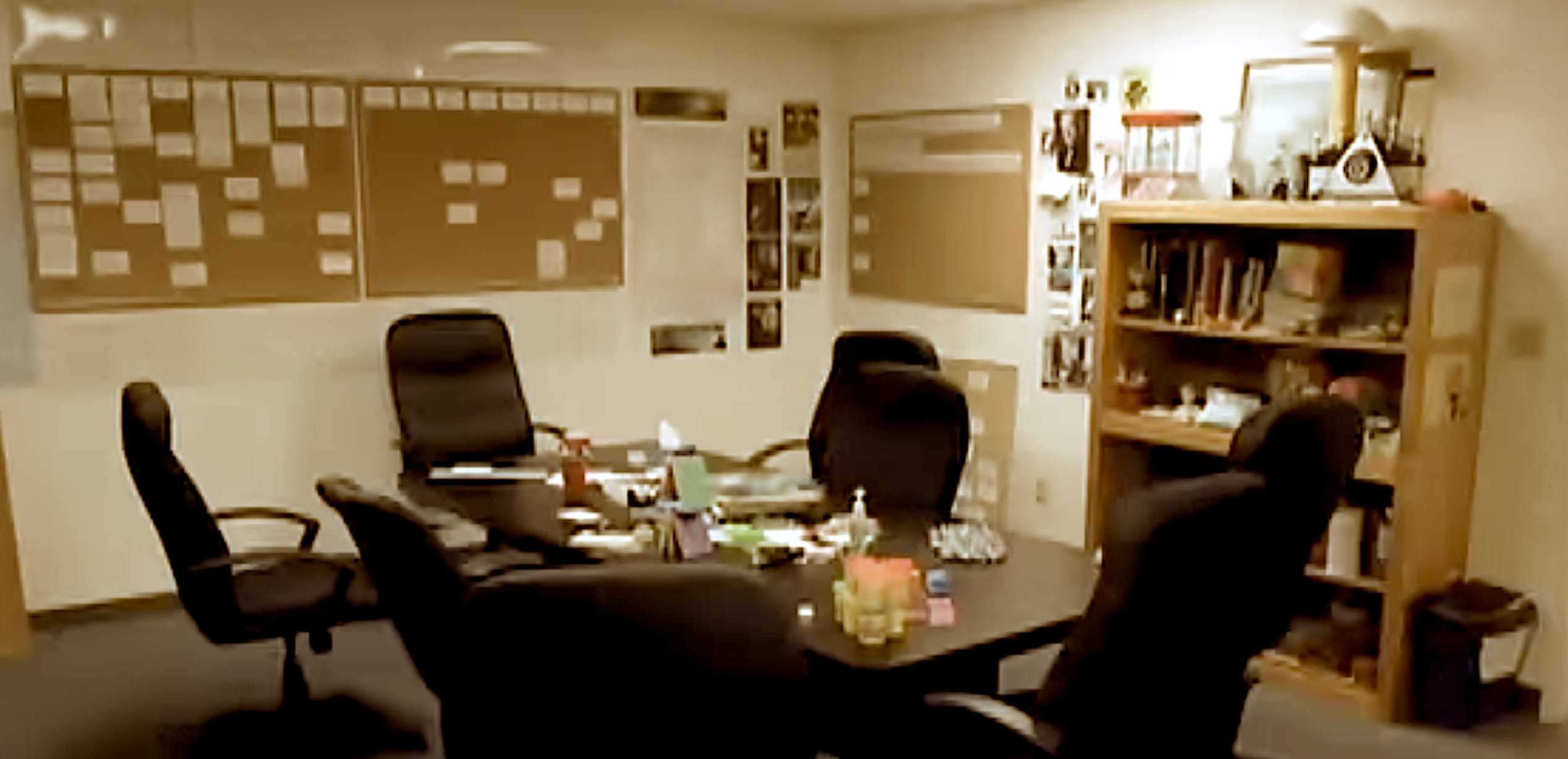
Breaking Bad Season 5 Writers’ Room
When Adversity Rears Its Head
But it’s not all plain sailing. Problems arise out of the blue all the time. Things can change very quickly, which may necessitate a complete rethink and reworking of storylines on short notice.
If you want to survive in a writers’ room and as part of a team, then the worst possible thing you can do when adversity rears its head is panic.
Don’t focus on the problem - focus on finding practical, workable solutions.
What you should expect is that the story you’re working on will change, probably in very dramatic ways, from what you were planning and thinking about. It could be a production issue, or a change of heart from the head creatives about the storyline, but hopefully, it’s not a case of the execs inserting their agenda into the mix.
Whatever it is, your job is to find a solution and execute it on the page.
I’ve been through many, many situations like this. One involved cutting a fully plotted six-episode run down to four episodes, which necessitated an emergency meeting between the key creatives involved to restructure the entire thing in an afternoon.
Another incident saw a writer realise at first draft stage that his main storyline was too thin to carry a full episode. We had half an hour to come up with something, but found a way by thinking outside the box and orchestrating a side quest storyline with a definitive ending that would not require pulling it through the remaining episodes and putting a strain on the wider, more important narratives.
These things happen, and if they happen to you, embrace them because they will sharpen your skills and make you much more adept at dealing with creative problems when they arise in the future.
Furthermore, someone is always paying attention, and if you’re the writer who comes up clutch for the team, guess who they’ll turn to next time?
No, not you - it’ll be someone at a much higher level!
But seriously, as they say, your reputation precedes you, so act accordingly.
Be The Writer Everyone Likes to Work With
That’s the key takeaway that you will hear from writers, directors and producers everywhere. Nobody wants to work with people they don’t like to be around - unless they’re being paid a boatload of money - and so, when hiring writers, you always want to be regarded as someone who is a net positive in a room.
Don’t get me wrong, it’s definitely not enough to be nice - you have to be good at what you do, too. But if you’re a competent writer who contributes to everyone else’s stories and tries to add value across the board, and also works hard when the time comes to deliver, then you will earn a reputation that can help you sustain a career.
I’m not trying to kid anyone here. It’s extremely tough to make a living as a screenwriter and to keep landing gigs to pay your bills and live. But what I would encourage any writer to do is to recognise and acknowledge an opportunity when it comes along and put everything you have into it.
Learn, improve, repeat and:
Keep writing.
Really enjoyed that. Thanks so much.
Absolutely SUPERB. Another great article Niall.